Section 634C Compliance: Why Extracting Digital Evidence Isn’t as Simple as It Looks
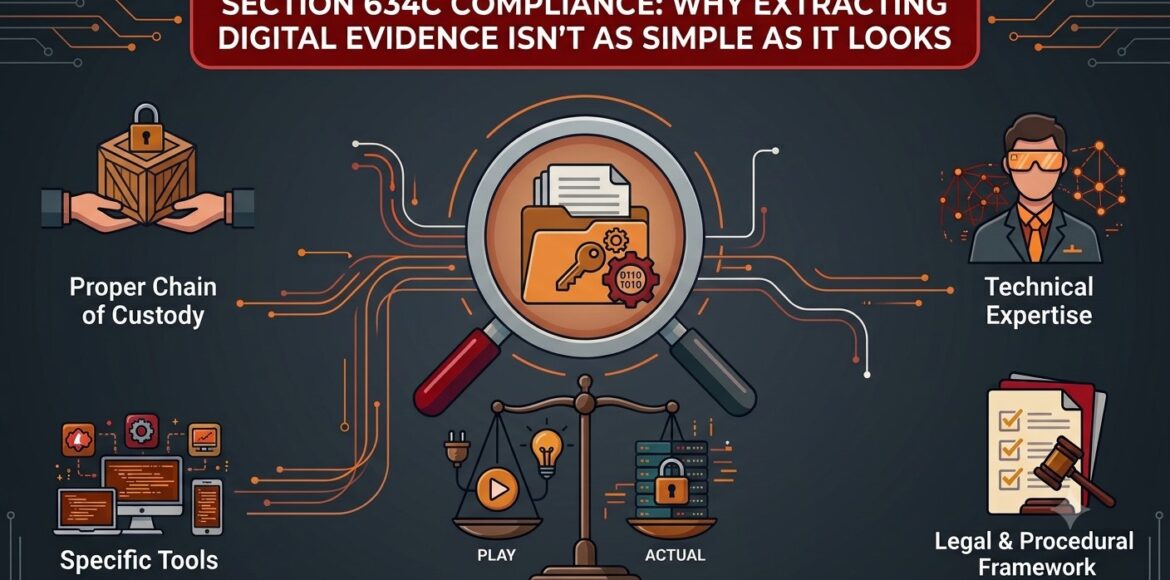
In the forensic profession, Section 634C is a critical legal provision that governs how electronic evidence must be handled. Most practitioners in the field know this section exists — but knowing it and actually aligning your extraction process with its requirements are two very different things. The technical and procedural details behind Section 634C compliance are complex, and there is no shortcut that makes the process simple.
It’s Not Enough to Just Cite Section 634C
One of the most important lessons for anyone working with digital evidence is this: simply submitting a report that references Section 634C does not automatically make it valid. A certificate or report only has real value if it can withstand cross-examination in court.
This isn’t a theoretical concern. There have been real cases where a client’s report failed to hold up under scrutiny — not because the evidence itself was wrong, but because the compliance process behind it wasn’t sound. In one such case, the judge ordered that the report be recompiled and resubmitted from scratch to bring it into full compliance. That kind of setback is costly, time-consuming, and entirely avoidable with the right approach from the start.
The Technical Components That Make or Break Compliance
Lawful extraction of electronic evidence under Section 634C depends on getting several technical parameters right. Here’s a quick-reference breakdown:
| Compliance Component | What It Involves | Why It Matters in Court |
| Device-specific handling | Laptop extraction differs fundamentally from mobile phone extraction | Treating all devices the same is one of the most common – and most damaging – mistakes |
| Part A & Part B requirements | Distinct sets of conditions that must both be satisfied for validity | Missing either part leaves the certificate open to challenge |
| Hash values | Generating and recording cryptographic hash values for the extracted data | Proves the data hasn’t been altered since extraction |
| Chain of custody | An unbroken, documented record of who handled the evidence and when | Establishes that evidence wasn’t tampered with at any stage |
| Metadata | Capturing metadata tied to the evidence source | Often carries as much evidentiary weight as the content itself |
| Date & time of extraction | Precise logging of when lawful extraction occurred | Anchors the evidence to a verifiable timeline |
Miss any one of these components, and the entire report becomes vulnerable to challenge.

There Is No “One-Size-Fits-All” Certificate
A common misconception is that there’s a standard template or a single “thumb rule” that makes any certificate automatically valid under Section 634C. There isn’t. The definitions, formats, and requirements change completely depending on where the evidence is coming from.
| Evidence Source | Compliance Focus |
| Cloud | Data custody, access logs, and provider-side authentication records |
| Laptop | Drive imaging, system logs, and hash verification at the disk level |
| Mobile Device | App-level data, device identifiers, and extraction tool logs |
| CCTV | Footage continuity, timestamp accuracy, and recorder-level metadata |
A certificate built for mobile phone extraction cannot simply be repurposed for CCTV evidence, and vice versa. Each source demands its own approach, its own documentation, and its own understanding of what “compliant” actually means.

The Path From Extraction to a Court-Ready Report
At a high level, getting from raw evidence to a certificate that survives cross-examination looks like this: 1. Identify the source → Cloud, laptop, mobile, or CCTV 2. Apply source-specific extraction protocol → Part A and Part B requirements 3. Generate hash values → confirm data integrity 4. 4. Document chain of custody → every handoff recorded 5. Capture metadata and exact date/time → anchor the evidence 6. Compile the certificate → matched to the correct format for that source 7. Stress-test against cross-examination → before it ever reaches the court.
Skipping or rushing any single step in this sequence is what leads to reports being sent back for recompilation.
Why Expertise Matters More Than Ever
Electronic devices and the technology behind them are constantly evolving. What counted as sufficient compliance a few years ago may no longer hold up today. Because of this constant shift, there’s no substitute for either developing a deep technical understanding of these requirements yourself or consulting with an expert who has one.
In digital forensics, the stakes are high – a report that fails in court doesn’t just delay a case, it can undermine the credibility of the evidence altogether. Getting Section 634C compliance right the first time isn’t just good practice; it’s what determines whether digital evidence actually holds up when it matters most.