Social Media’s “Big Tobacco” Moment: Inside New Mexico’s Landmark Case Against Meta
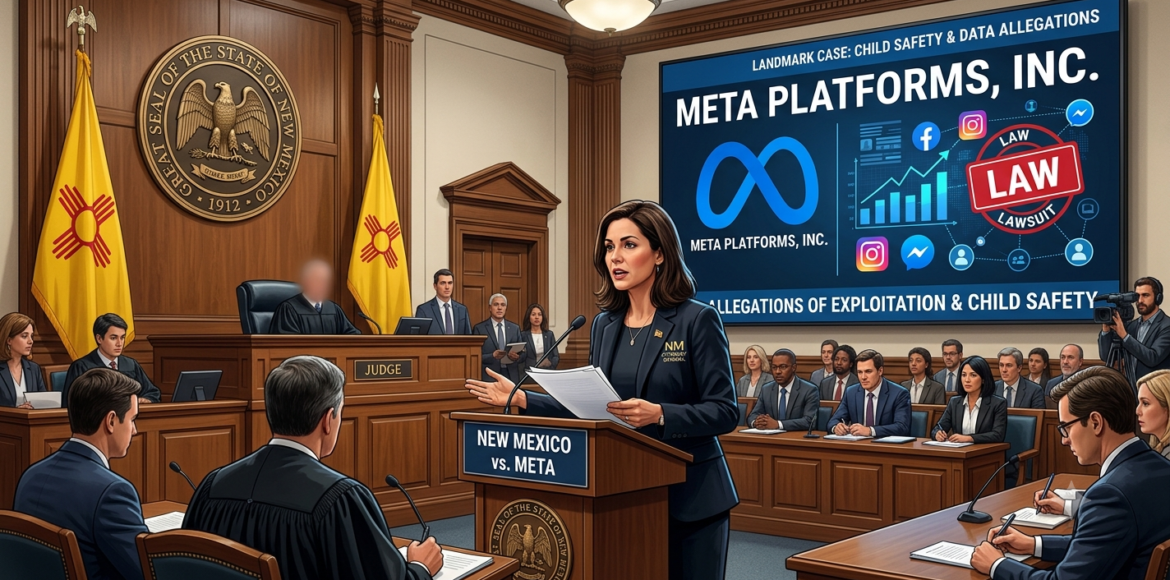
Usually, when a company gets in legal trouble, it’s because it got hacked or broke a rule by accident. This case was different. Meta – the company behind Facebook, Instagram, and WhatsApp – got in trouble for something it knew was happening but didn’t fix. In 2026, a court in New Mexico made Meta pay more than $940 million. People are now comparing it to the famous tobacco company lawsuits from the 1990s.
How the Case Began
In 2023, New Mexico’s top lawyer, Attorney General Raúl Torrez, filed a lawsuit against Meta. He said Instagram and Facebook were unsafe for kids – that predators were using these apps to target children – and that Meta knew about it but didn’t tell the public the truth.
To prove this, his team didn’t just collect complaints. They went undercover. They made a fake social media profile pretending to be a 13-year-old girl. Almost right away, that fake profile started getting inappropriate messages and images from adults. This showed, in real time, how easily a child could be targeted on the app.
The state also claimed something big: around 500,000 inappropriate interactions with children happen every single day across Meta’s apps – and that Meta wasn’t properly tracking or stopping most of them.

Building the Case: Internal Documents as Evidence
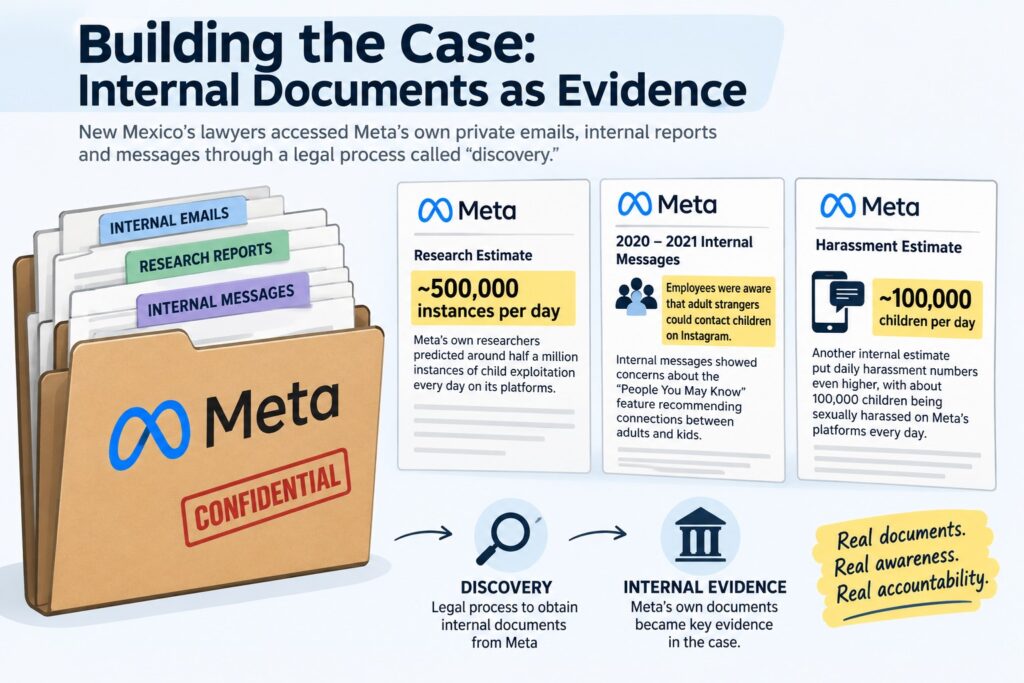
This part of the case is really interesting. Instead of relying only on outside proof, New Mexico’s lawyers got access to Meta’s own private emails, internal reports, and messages through the legal process called “discovery.”
Here are a few real examples of what turned up once those documents were unsealed:
-
- Meta researchers had already estimated the scale of the problem. Internal memos showed Meta’s own researchers were predicting around half a million instances of child exploitation happening every single day on its platforms – a number the company never shared with the public.
-
- Employees flagged the exact same dangers years earlier. Internal messages and presentations from 2020 and 2021 showed Meta staff were aware that adult strangers could contact children on Instagram, and had raised concerns about the “People You May Know” feature recommending connections between adults and kids.
-
- A separate internal estimate put daily harassment numbers even higher. In documents connected to the case, Meta employees separately estimated that about 100,000 children were being sexually harassed on the company’s platforms every day.
What did all this add up to? Meta’s own employees had warned the company for years about these dangers. Outside child-safety experts had warned them too. But the state argued Meta ignored these warnings and kept telling the public that its apps were safe.This matters because it shows something important: a company’s own private records can end up being the strongest evidence against it – stronger than anything an outsider could dig up.
The Trial
The trial began on February 9, 2026, in a courtroom in Santa Fe, New Mexico. It lasted about seven weeks.
New Mexico’s lawyer, Don Migliori, told the jury that Meta made money while hiding what it knew about the dangers on its platform. Meta’s lawyer, Kevin Huff, pushed back – he said Meta had been honest, that it publishes regular reports on harmful content, and that it works to remove such content. Meta argued it couldn’t be blamed for everything bad that happens online.Many people testified during the trial: teachers, mental health experts, former Meta employees, and government investigators. Jurors even watched a recorded video of Mark Zuckerberg, Meta’s CEO, answering questions under oath.
The Verdicts
There were two major decisions in this case.
March 2026 – First ruling: The jury decided Meta broke New Mexico’s consumer protection laws by misleading people about how safe its apps really were. Meta was ordered to pay $375 million.
August 2026 – Second ruling: The court then had to answer a bigger question: was Meta a “public nuisance” – meaning, did its apps cause widespread harm to the public, similar to a factory polluting a town? The judge said yes. Meta was ordered to pay another $567 million into a special fund. Most of that – $420 million – will go toward helping young people who were harmed. The rest will fund awareness and prevention programs over the next five years.
Add both rulings together, and Meta now owes more than $940 million because of this one case.
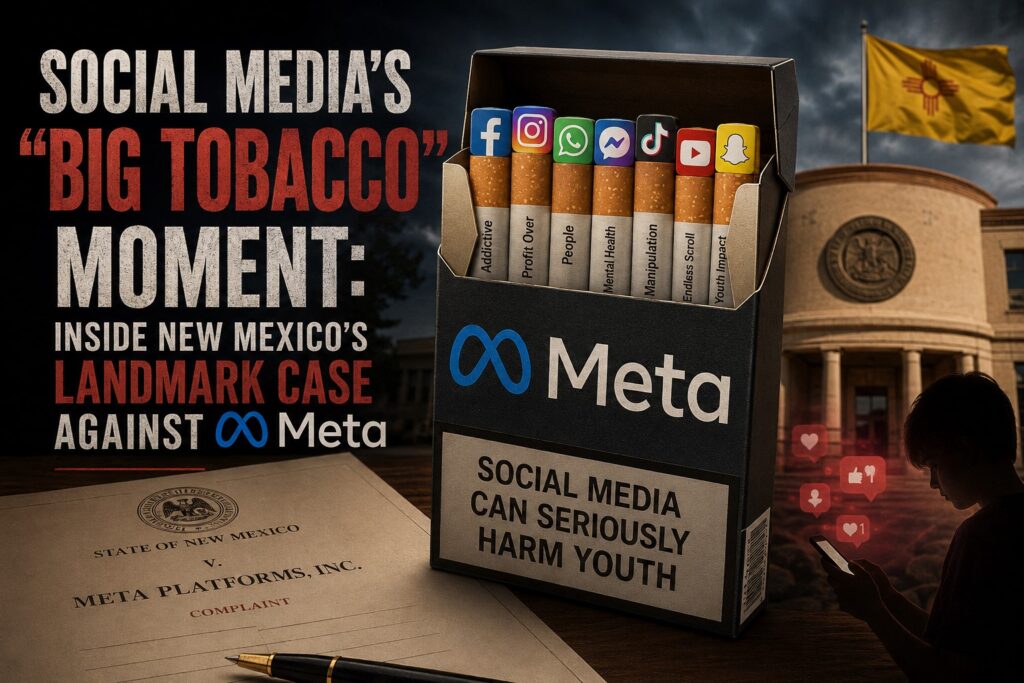
Why It’s Being Called Social Media’s “Big Tobacco” Moment
Years ago, tobacco companies were sued in a very similar way. Lawyers proved that cigarette companies knew smoking was dangerous, but hid that information from the public for years. Courts eventually made those companies pay huge amounts of money.
People are comparing Meta’s case to that because the pattern looks the same:
-
- A company knew about a serious danger
-
- It didn’t tell the public the full truth
-
- Courts stepped in and made it pay to fix the harm
Many legal experts think this case could open the door for similar lawsuits against other big tech companies, in other states, going forward.
Where the Case Stands Now
As things stand, Meta owes more than $940 million total – combining the March 2026 penalty and the August 2026 fund payment. Meta has said it disagrees with the case, and that it has invested heavily in safety tools and parental controls to protect young users. Given how large the payment is, Meta will likely try to appeal the decision, which means this case may not be fully over yet, even after three years of legal fighting.
What Parents Are Saying
Behind the legal filings and dollar figures, this case is really about families. Attorney General Raúl Torrez said the verdict was a historic victory for every child and family, adding that Meta’s own executives knew their products were harming children, ignored warnings from their own staff, and misled the public about what the company actually knew.
Parent advocacy groups that supported the case echoed the same message throughout the trial: parents trust these apps with their kids every day, often without realizing how much internal knowledge companies may have about the risks their own children face. For many parents watching this case, the verdict felt less like a legal technicality and more like simple validation — confirmation that the platforms their children use every day were not being run as safely as they were told.
This is also why the compensation fund matters so much. By directing $420 million specifically toward treatment services for affected young people, the ruling tries to address not just the company’s conduct, but the real, lasting harm experienced by children and the families supporting them.
A Message for Indian Parents
This case happened in the US, but Instagram, Facebook, and WhatsApp are used by millions of Indian children every day — so the lessons apply here too.
- The risk is documented, not guesswork. Meta’s own internal data showed hundreds of thousands of harmful interactions with children daily — a real signal to take online safety seriously.
- India has its own protections. The POCSO Act, 2012 and IT Rules, 2021 cover online exploitation. Report concerns via the Cyber Crime helpline 1930 or cybercrime.gov.in.
- Talk before a crisis, not after. Ongoing conversations with kids about online strangers are one of the strongest protections parents actually control.
- Save evidence quickly. Screenshots and chat logs, kept without editing, are often key if a case ever needs to be reported.
How This Connects to Digital and Cyber Forensics
This case is a great real-world example of how digital forensics isn’t only about catching hackers — it’s also about proving what a company knew, and when. In criminal cybercrime cases, forensic experts usually recover evidence from devices, phones, or servers after a crime happens. In this case, the “evidence” was internal company records — emails, chat logs, research reports, and presentations — pulled out through the legal discovery process instead of a forensic device search.
Both approaches share the same core forensic principle: build a clear, provable timeline of digital evidence that a court can trust. Whether it’s a recovered phone in a criminal case or an unsealed internal memo in a civil lawsuit, the goal of digital forensics is always the same — turning scattered digital records into evidence strong enough to hold up in court.
If you want to go deeper into how digital and cyber forensic investigations actually work — including how digital evidence is extracted, preserved, and used in real Indian legal cases — Crypto Forensic Technology’s blog is a good resource to explore: https://cryptoforensic.in/our-blog-01/ It covers practical, India-focused topics like digital evidence extraction, compliance requirements, and cyber forensics techniques.
Why This Case Matters Beyond New Mexico:
It shows a new way to prove wrongdoing. This case didn’t rely on hacked data or stolen files – it relied on a company’s own internal records. That’s a powerful reminder that what a company writes down privately can be used against it later in court.
-
- It shows investigators can act, not just watch. By creating a fake child profile, New Mexico’s team actively tested how the platform would respond, instead of just waiting for complaints to come in.
-
- It could change how tech companies are held responsible. If more states follow this same approach, tech companies everywhere may face more pressure to be careful – and honest – about protecting children online.
As more states and countries start asking tough questions about how social media platforms treat young users, this case is likely to be remembered as a turning point – both for how much money was involved, and for how the case was actually proven.